

Generative AI has changed how we create content, find information, and interact with technology. But for businesses, the more important shift is only beginning. The next generation of enterprise AI will not simply answer questions. It will increasingly interact with the systems, data, and processes where business actually happens. For industrial companies, that means ERP.
From information to action
ERP systems contain much of the operational context a business depends on every day: customers, suppliers, orders, products, production plans, financial transactions, quality records, and more. Traditionally, working with this information requires people to understand where it is stored and how the relevant ERP process works. AI introduces a different starting point: what the person wants to achieve.
Instead of navigating through applications, screens, and fields, imagine starting with a request such as:
-
Show me the sales orders created this week.
-
What is planned for production over the next three weeks?
-
Help me prepare this supplier invoice.
-
Create a quality issue based on this information.
Once AI can connect with the ERP system behind these requests, the interaction begins to change.
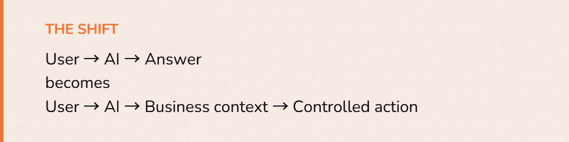
And that is where AI becomes considerably more interesting for business.
AI that understands the operational context
Connecting AI to ERP is not simply about giving an AI model access to more data. To create practical value, AI needs to understand the context around that data and the capabilities available within the business system.
In RamBase, the Model Context Protocol (MCP) provides one way to create that connection. The RamBase MCP Server allows compatible AI environments to interact with capabilities exposed through RamBase APIs. This means organizations can potentially use AI to do more than retrieve information. Depending on available capabilities and permissions, AI can also support the creation and updating of ERP records.
RamBase scenarios have already demonstrated applications including operational search, quality issue creation, supplier invoice processing, and record creation and updates.
“We see great potential in MCP to unlock the full potential of RamBase, support our growth and reduce the pressure on our organization as we scale. With MCP and RamBase data, the possibilities are really only limited by our imagination.”
Bård Ivan Dyrendahl, Sales Manager Industry and Rail, Procab
From AI assistants to AI agents
This also creates the foundation for another shift: from AI assistants to AI agents.
-
An assistant typically responds to a request.
-
An agent can work toward a defined outcome using several steps, tools, and sources of information.
In an ERP environment, that could eventually mean specialized AI agents designed around well-defined business processes. But greater capability must also come with greater control.
Organizations need to determine what information an agent may access, which actions it can perform, when human approval is required, and how those actions can be reviewed.
The future of AI in ERP is therefore not simply about making AI more autonomous. It is about making AI operationally useful and appropriately controlled.
Start with business value
The question for industrial companies is no longer simply: “How can we use AI?”
A more useful question is: Where does unnecessary friction exist between information and action?
That might be time spent finding operational information, manually interpreting documents, entering repetitive data, identifying exceptions, or moving information between processes. Those are the places where AI could start creating measurable value.
Want to explore what this could mean for your business?
Our whitepaper From ERP for People to ERP for People and AI explores how AI can connect with operational ERP data, processes, and business logic, including practical use cases, customer experience, MCP, governance, and a path from AI assistance to controlled automation.