.png?width=1920&height=410&name=RamBase-Logo-Standard-Dark%20(5).png)

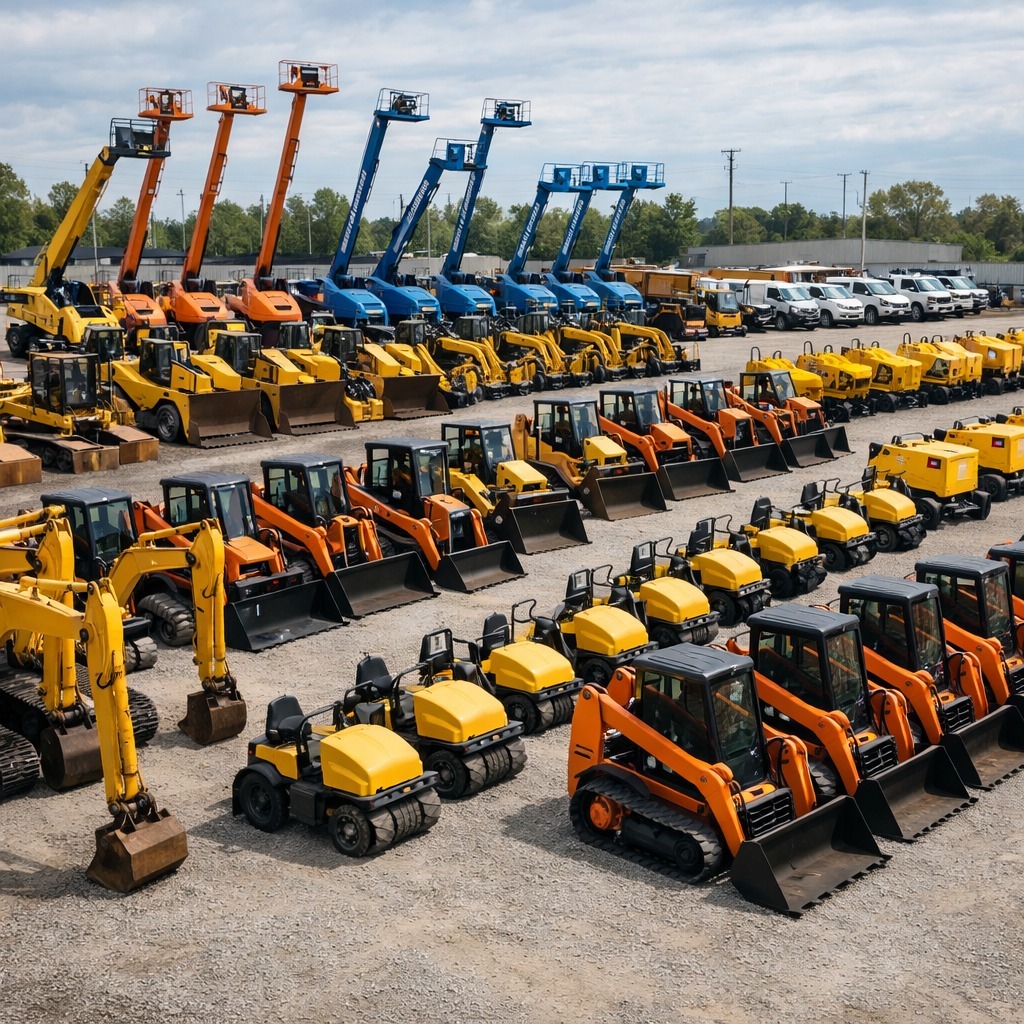
Across many industrial sectors, equipment rental has evolved far beyond a simple hire model. Increasingly, businesses are moving towards service‑based operating models including rental, subscription, pay‑per‑use and product‑as‑a‑service. For companies supplying specialist equipment, engineered tools or industrial machinery, rental is often no longer just an additional revenue stream. It has become a core commercial model.
But while the business model evolves, the systems supporting it often don’t.
The cost of operating through disconnected systems
Many rental businesses find themselves managing operations across multiple disconnected systems such as spreadsheets, finance software, asset tracking tools, service systems and CRM platforms. Individually these tools may work well. Together, they rarely provide a complete operational picture. Common challenges quickly emerge, including:
-
Limited visibility of fleet availability, location and utilisation.
-
Difficulty planning maintenance, inspection and turnaround.
-
Fragmented workflows between contracts, service, inventory and finance.
-
Unclear linkage between asset utilisation and financial performance.
-
Manual processes around check in, check out and invoicing.
Over time, these gaps create operational friction. Equipment may sit idle without anyone realising. Service scheduling becomes reactive rather than planned. Financial visibility lags behind operational reality. For organisations managing high‑value or specialist assets, that lack of control can quickly become costly.
The shift toward long-term asset lifecycle relationships
Another shift happening across industrial sectors is the move away from one‑off equipment sales towards longer lifecycle relationships with customers. Instead of selling a product and stepping away, many companies now manage rental contracts, installation and commissioning, inspections and certifications, preventative maintenance, and repair or refurbishment.
This creates significant opportunity, but it also introduces operational complexity. Managing the full lifecycle of equipment from deployment to service to return requires systems that treat assets as operational entities, not simply items on a sales order.
A single system approach to smarter rental operations
One of the biggest limitations we see in rental businesses is that rental operations sit outside the main operational system. Rental tools may manage bookings, while service software handles maintenance, finance manages invoicing, and spreadsheets track asset availability. The result is fragmented visibility and unnecessary complexity.
A more effective approach is to manage rental operations within the core ERP platform, connecting contracts and customer management, equipment availability and asset tracking, service, inspection and maintenance, logistics and dispatch, and utilisation linked directly to financial performance.
When these areas operate together, organisations gain far greater control over fleet utilisation, turnaround time and operational efficiency.
Rental as a core capability in RamBase Cloud ERP
Many ERP systems treat rental as an afterthought. By contrast, RamBase Cloud ERP supports equipment rental as part of the core operational platform, allowing companies to manage the entire lifecycle of their assets within one system.
This is particularly valuable for three types of organisations:
-
Equipment rental specialists: Businesses whose primary model is the rental of industrial equipment or specialist assets, where utilisation, availability and turnaround directly determine profitability.
-
Manufacturers that also operate rental fleets: Engineering companies that both manufacture equipment and offer it through rental or service-based models alongside traditional sales, service and maintenance.
- Manufacturers exploring rental as a new business model: Organisations that currently sell equipment outright but are beginning to consider introducing rental, subscription or “equipment-as-a-service” models to create recurring revenue and closer customer relationships.
By connecting rental operations directly with manufacturing, inventory, service and finance, organisations gain a single operational view of fleet availability and location, equipment utilisation, service history and compliance documentation, and lifecycle costs and asset profitability.
Building the foundation for a scalable, service‑driven rental operation
Across sectors including industrial equipment, engineered tools, robotics, lifting equipment and specialist machinery, rental models continue to grow. The opportunity is significant, but only if operations are structured to support it.
Businesses that gain full visibility into their asset lifecycle, utilisation and service operations are able to scale rental models confidently while maintaining control over performance and profitability.
If you’d like to explore how this works in practice, please visit our equipment rental page.
If you want to see a demo you can request it here.